
Midterm Elections & Stock Market Volatility as a Business Owner: My $50K Drop & $20K Debt Payoff
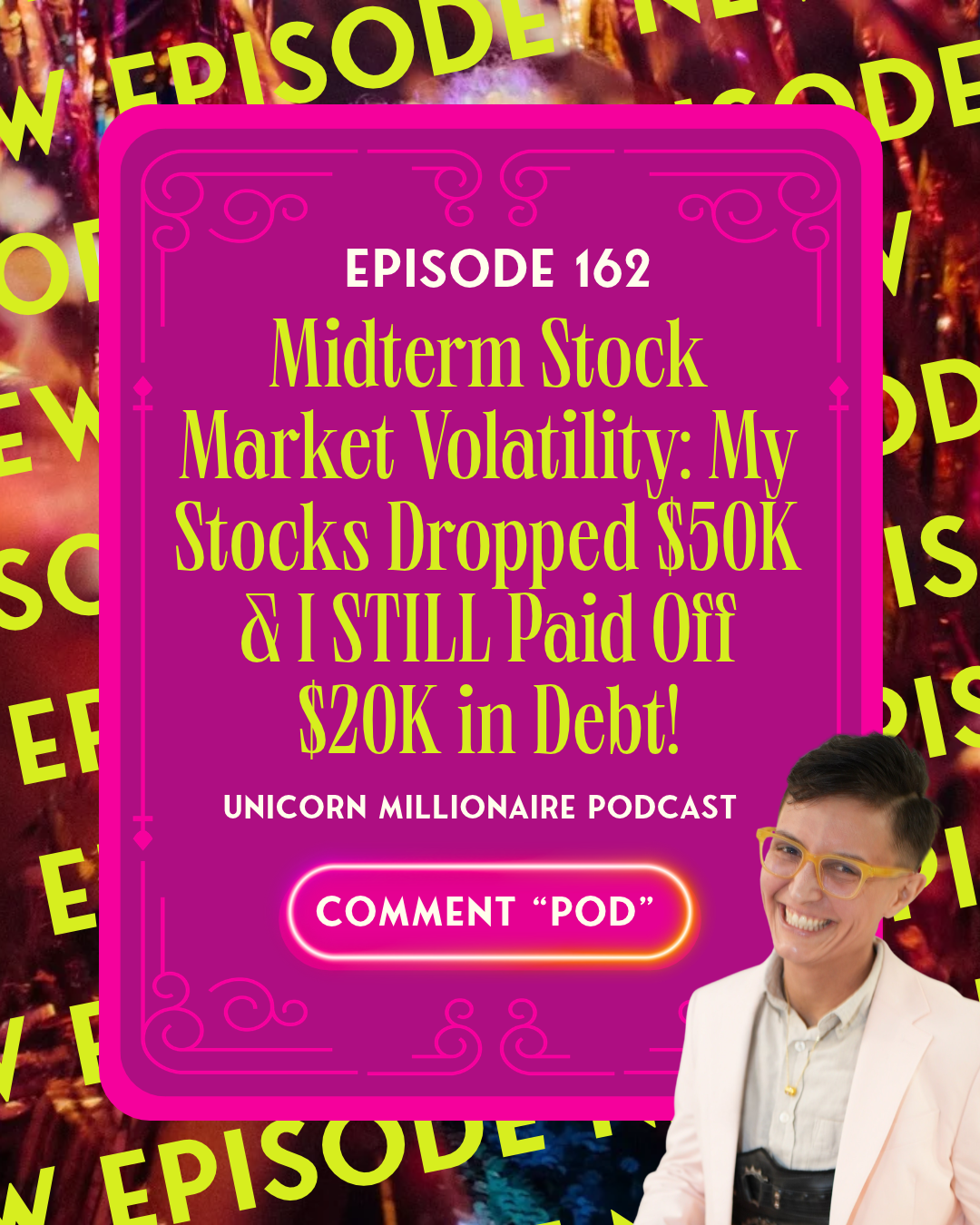
My stocks dropped about $50K in a month. I still crushed about $20K in business credit card debt without paying interest. And I’m building wealth peacefully!
How do we handle midterm elections and stock market volatility as business owners? When business income is inconsistent and our investments fluctuate, understanding our cash needs, giving debt a payoff plan, and knowing what we own helps us make decisions instead of reacting to every headline.
As a trans Latinx money coach and former stockbroker, I want that confidence for US. We deserve to understand our dinero and use it to build more freedom—even when the numbers are doing the most.
Listen to episode 162: midterm elections, the stock market, and business finances
Hear the full conversation about investing as a business owner, managing inconsistent income, and paying off business debt during stock market volatility.
🎧 Listen to episode 162 of the Unicorn Millionaire Podcast on Spotify
🎧 Listen to episode 162 of the Unicorn Millionaire Podcast on Apple Podcasts
Watch the episode on YouTube
Midterm elections and stock market volatility as a business owner
I can celebrate an election outcome and still see my investment balance fall. The blue wave euphoria I describe in this episode and my portfolio’s daily performance are two different things.
In episode 162 of the Unicorn Millionaire Podcast, I talk about the 2026 midterm elections, the AI and big tech selloff, and how I feel watching my accounts fluctuate.
However, elections alone don’t explain every market move. Company earnings, interest rates, economic conditions, and investor expectations also matter. Fidelity’s guide to midterm elections and the stock market provides useful historical context.
When stock market volatility shows up in my accounts, I want to ask: Has my need for the money changed? Do I understand the risks in my holdings? Am I looking at a short-term move or my progress over several years?
A lower balance doesn’t erase every previous gain
I started investing at 27. At 36, I haven’t even been investing for ten years. Yet learning how my money works has helped me build wealth while running a business and paying myself no more than $45K a year.
That progress has not followed a straight line. I’ve seen individual stocks rise, fall, and—in one expensive case—become an investment in a company that went bankrupt.
I don’t want us confusing a difficult month with our entire financial future. At the same time, a lower balance is a reason to understand our investments, not assume that every stock will recover.
Account value is also different from investment performance. A balance can change because of deposits, withdrawals, fees, and market movements. We need those details before calling the entire change a market loss.
Give business debt a payoff plan
Alongside the market swings, I paid off about $20K in business credit card debt. I had used introductory 0% APR offers for business investments and expenses, while earning rewards along the way.
Before interest began, I used cash to pay off those balances. The payoff plan mattered as much as the offer.
A welcome bonus can feel exciting. But interest, fees, and unnecessary spending can eat up its value. Therefore, I want us looking at the full picture before applying:
- When does the introductory rate end?
- Which purchases or transfers qualify?
- What fees and minimum payments apply?
- What spending is required to earn the bonus?
- Where will the payoff money come from?
In my companion article, I explain how Wells Fargo and Bank of America business credit cards paid me in perks. Those are my results with specific offers—not a promise that every card or application will produce the same outcome.
Paying off debt and measuring net worth are different
If we pay $20K of debt with $20K of cash, assets and liabilities generally fall by the same amount. The payment itself doesn’t create a $20K net worth loss.
That distinction matters when we review our finances. Our cash balance, credit card balance, investment account value, and net worth each tell us something different.
For business owners, separating business and personal finances can make those numbers easier to understand. Revenue isn’t take-home pay, and available credit isn’t income.
Know what we own—and why
One of my individual stock holdings is AMD. In the episode, I explain how I first bought it and how much luck played a role. I also share an expensive lesson from investing in a company that later went bankrupt.
Those experiences helped shape my approach to new investments. I talk about using low-cost index funds rather than trying to keep picking individual winners.
Owning one company exposes us to that company’s specific risks. A diversified fund spreads investments across multiple holdings, although it can still lose value during stock market volatility.
Opening a Roth IRA or 401(k) is one step. Understanding what we hold inside it is another.
Stop guessing with your investments
What funds or companies do we own? How concentrated are our investments? What fees are we paying? When do we expect to use this money?
We deserve answers we understand. Otherwise, every headline can feel like a new instruction—even when it has little to do with our personal goals.
Inside coaching, we look at actual accounts together. We connect the numbers to upcoming expenses, business investments, retirement, and the freedom to work less. I want us making informed decisions instead of collecting random accounts and hoping they add up to a plan.
Our financial well-being belongs in the mission
We can say “f**k big tech,” question capitalism, and still invest in our futures. We can organize for something better while learning to navigate the system we’re living in.
I want our businesses to pay us well. Financial capacity can give us more choices about rest, donations, free resources, and how we support our communities without running ourselves into the ground.
Midterm elections, stock market volatility, and uneven income don’t remove our need for care. Our financial well-being belongs in the mission, too.
Get help connecting your cash, credit, and investments
In Six-Month Money Coaching, I help LGBTQ+, BIPOC, first-gen, and neurodivergent folks understand their accounts and optimize their money with their current income. We work together, live, so you can stop second-guessing your money moves and build toward being work optional.
Reading before November 10, 2026? Join my free live webinar, Business Owners: Find $10K+ in Hidden Business Benefits Before 2027, on November 10 at 1 PM Pacific / 4 PM Eastern. We’ll explore perks, points, eligible write-offs, and retirement accounts, with live Q&A. No replay!
Reading afterward? Explore current coaching options and use the email signup on this website to join Dom Your Dinero. Let’s be our own sugar daddies now who still retire early.
Frequently asked questions about midterm elections and the stock market
How do I handle stock market volatility as a business owner?
Separate upcoming cash needs from longer-term investment goals. Then review your holdings, concentration, fees, and risk. In this episode, I share how understanding those pieces helps me respond to uncertainty.
Can I invest while paying off business debt?
It depends on cash flow, debt costs, repayment obligations, and goals. My experience involved introductory 0% APR offers and a payoff plan. Carrying expensive debt to invest creates different risks and tradeoffs.
Does paying off debt reduce net worth?
Paying debt principal with cash generally reduces assets and liabilities equally. Interest and fees are expenses, but repaying principal itself generally doesn’t reduce net worth.
Does an election result tell me what stocks to buy?
No. Election outcomes are one input among many. They don’t make individual company performance predictable or guarantee that a sector will rise or fall.
Keep listening: business rewards, financial foundations, and client results
- Episode 160: How Wells Fargo and Bank of America business credit cards paid me $1,200+ in perks. Explore the rewards side of business spending and the importance of a payoff plan.
- Episode 161: How Michelle grew her net worth by 25% before starting her business. See how personal finances can support travel and entrepreneurship.
- How to separate business and personal finances before tax season. Build clearer records around business expenses and owner pay.
Keep optimizing your dinero
Want a clearer plan for the money you already have? Explore six-month private money coaching and book a free clarity call. We work on your actual cash, credit, investments, and decisions together, live.
Get my free Dom Your Dinero emails: visit my website to sign up for money moves, personal stories, and support building wealth on your terms.
About Charly Stoever
I’m Charly (they/he), a nonbinary Latinx money coach, former stockbroker, and host of the Unicorn Millionaire Podcast. I help our communities optimize cash, credit, and investments so our money supports our lives today and our freedom in the future.